Can you advertise Botox in the UK? What a clinic can and cannot say
No: botulinum toxin is a prescription-only medicine and cannot be advertised to the public. What CAP rule 12.12 allows instead on a clinic website and on social media, with the ASA's own examples.
By Daniel Stoychev, Webso Digital · 2 October 2026 · 8 min read
Sources checked against the regulator's own pages on 2 October 2026.
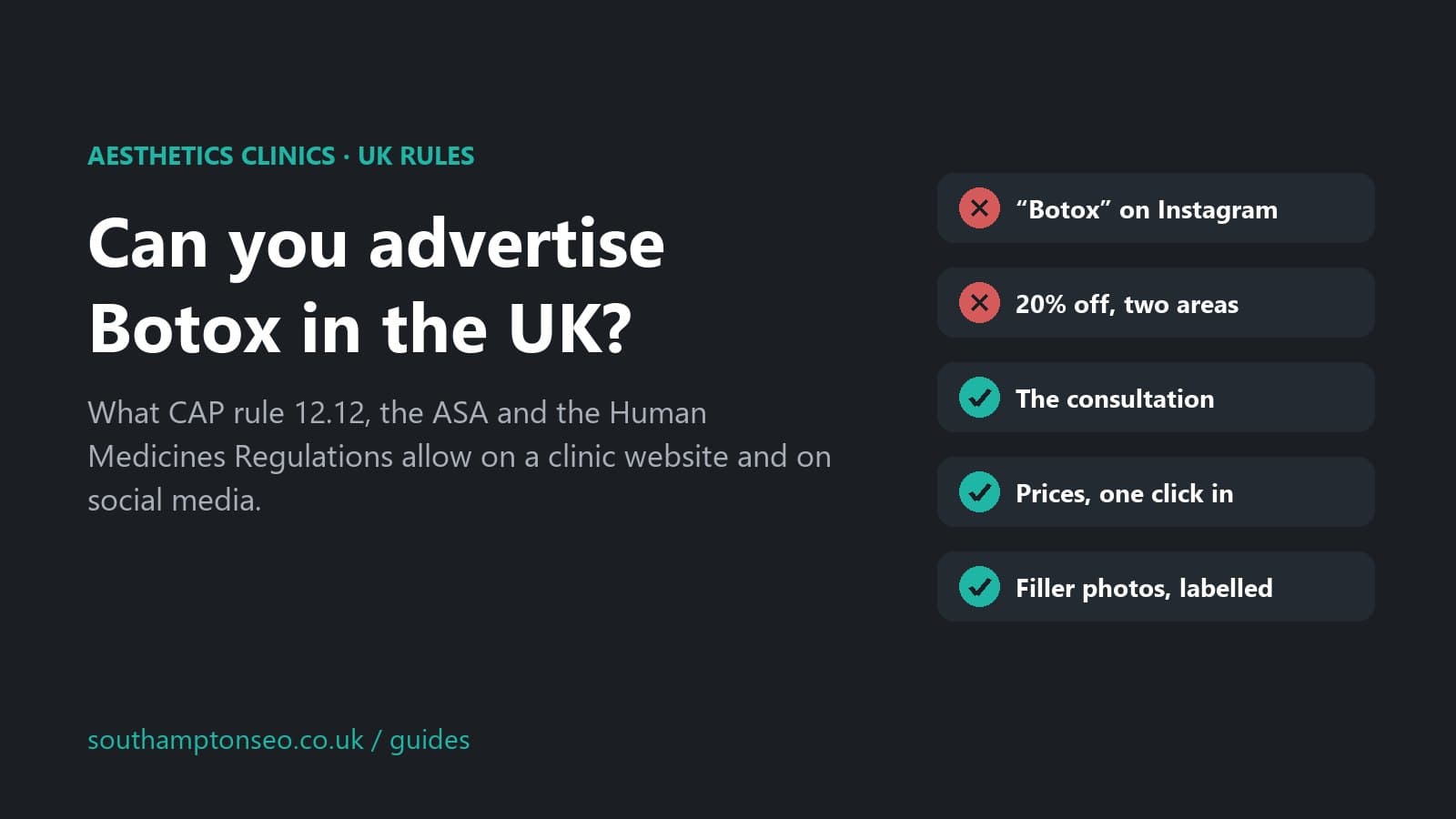
No. Botulinum toxin, sold as Botox, Azzalure, Bocouture, Dysport and Vistabel, is a prescription-only medicine, and prescription-only medicines may not be advertised to the public in the UK. The rule is CAP Code rule 12.12, enforced by the Advertising Standards Authority, and behind it sits the law: regulation 284 of the Human Medicines Regulations 2012. It applies to a clinic's own website as well as to social media. What a clinic can promote is the consultation, with any mention of the medicine kept incidental, balanced and factual.
What the rule actually says
Rule 12.12 of the CAP Code is one sentence: "Prescription-only medicines or prescription-only medical treatments may not be advertised to the public." The law it rests on is just as short. Regulation 284(1) of the Human Medicines Regulations 2012 says: "A person may not publish an advertisement that is likely to lead to the use of a prescription only medicine."
Nothing in either depends on who gives the injection. A doctor, a dentist, a nurse prescriber and a pharmacist are bound by the same rule as anyone else, and the ASA has said so in terms. Nor did anything change recently: when the ASA sent its enforcement notice on botulinum toxin to the aesthetics sector, it said the rules had been in force for some time and were based on legislation.
Which treatments it covers
Every prescription-only botulinum toxin product, under any brand name, and in fact every prescription-only medicine. The ASA uses 'Botox' as shorthand for all of them. The rule does not cover injectable treatments that are not prescription-only medicines, such as dermal fillers, which is why the wording rules below depend on whether a clinic offers both.
Does it apply to your website, or only to Instagram?
Both. The ASA's own answer is that rule 12.12 applies to all marketing material and advertising, including posters, leaflets, press ads and the clinic's own website, with some narrow exceptions on a website that are set out below. Its enforcement notice concentrated on social media because that is where it was seeing the most breaches, and it said it would use monitoring technology to find problem posts and work with the platforms to have them removed. Repeated, deliberate breaches can be referred to the MHRA or to the practitioner's professional regulator.
What you can say on your website
The ASA allows a clinic website to refer to botulinum toxin in very narrow circumstances. The page must make clear that what is being advertised is the consultation, not the medicine; it should not be easy for a visitor to stumble on information about a prescription-only medicine; and any reference to it must be incidental, balanced and factual. The ASA's own example is a 'wrinkle treatment consultation' link on the home page, leading to a page that emphasises a consultation with a range of treatment options, where botulinum toxin appears as one possible option among others.
A clinic can go a step further and put the treatment options, or a price list, one click behind that consultation page. The price list can mention botulinum toxin alongside its price, provided it is genuinely only a price list. What the ASA says is unlikely to be acceptable is a price on the home page, or a 'Prices' link straight from the home page to a list that mentions it. Claims such as "gives you beautifully smooth skin" or "the injections do not hurt at all" are, in the ASA's words, unlikely to be considered purely factual information.
The wording, phrase by phrase
Most of the questions clinics ask are about particular phrases. The table summarises the ASA's published answers; the right-hand column is the reason it gives.
| What the ad or page says | Likely acceptable? | Why |
|---|---|---|
| "Botox", or any brand name, in a social post, a paid ad or a headline | No | A direct advertisement for a prescription-only medicine, which rule 12.12 prohibits. |
| "20% off", "two areas for the price of one", "refer a friend" | No, even on your own website | A price promotion is promotional, not factual, and its focus is the product rather than the consultation. |
| "Wrinkle treatment consultation", leading to a page of options | Yes, if the options are real | The consultation is what is advertised; the medicine is one incidental option. |
| "Anti-wrinkle injections" or "anti-wrinkle treatments", where you offer both toxin and non-prescription treatments | Possibly | Acceptable as a collective term, as long as nothing else implies 'injections' means the toxin alone. |
| "Anti-wrinkle injections and fillers" | No | Listing fillers separately implies the 'injections' are the toxin. |
| "Anti-wrinkle injections", where you only offer toxin | No | Likely to be read as an implied ad for a prescription-only medicine. |
| "Wrinkle-relaxing injections" | No | 'Relaxing' is understood as a reference to botulinum toxin, whatever else you offer. |
| A price list mentioning botulinum toxin, reached from the consultation page | Possibly | Acceptable if it is genuinely only a price list and not on social media, mailed out or in paid space. |
Before-and-after photographs
A before-and-after image of someone treated with botulinum toxin is likely to be seen as an ad for it, so it is out. If you also offer non-prescription treatments such as filler, you can show images of those, provided you say explicitly which treatment the photos show. Presenting a toxin result as a filler result would be materially misleading. For any before-and-after image, the ASA expects you to hold signed and dated proof that it is genuine and representative of what can be achieved, and its wider guidance on cosmetic interventions says the treated area should not be retouched.
Hyperhidrosis and other medical uses
The rule is the same whether the treatment is for lines or for excessive sweating. A clinic cannot advertise botulinum toxin for hyperhidrosis to the public either, and the website needs the same consultation-led approach.
What to do about old posts
The ASA has said its focus is on marketers changing what they do from now on, but that ideally you should remove or amend problem posts that are current and easily visible without scrolling far back. In practice that means the pinned posts, the highlights, the bio and the link-in-bio page, and anything from the last few months. If its compliance team finds problem posts, it works with the platforms to have them taken down.
The other CAP rules every aesthetics page has to meet
- Ads for cosmetic interventions must not be directed at people under 18. That covers the content, the platforms chosen and the audience targeting.
- Objective claims about what a treatment achieves need robust evidence. Words like 'revolutionary' or 'turns back time' are claims, not decoration.
- Testimonials must be socially responsible: they must not make a procedure look trivial or exaggerate the result, and any claim inside one needs the same evidence as if you had made it yourself.
- Before-and-after images must reflect genuine results, without retouching the treated area.
What is changing: licensing in England and Scotland
Licensing is about who may give treatments and where, not about advertising, so it does not change rule 12.12. It will change what a clinic's site needs to show. On 6 August 2025 the Department of Health and Social Care announced that the highest-risk procedures would be restricted to qualified healthcare professionals in CQC-registered providers, that lower-risk treatments including botulinum toxin and dermal fillers would need a local authority licence, and that it planned age restrictions for under-18s. Those measures need secondary legislation, and the department said further public consultation would come first.
In Scotland, the Civic Government (Scotland) Act 1982 (Licensing of Non-surgical Procedures) Order 2026 makes the provision of non-surgical procedures a licensed activity, with a licence required from 6 September 2027. Whichever applies to you, check the current position on GOV.UK or legislation.gov.uk before quoting a date on your site, and when a licence is issued, show it.
A checklist for an aesthetics clinic website
- No brand name or 'toxin' in page titles, headings, meta descriptions, image file names or alt text, so search results do not advertise it either.
- The home page and navigation lead to consultations and concerns (lines, volume, skin quality, sweating), not to medicines.
- Any reference to botulinum toxin sits on a consultation or treatment-options page, is factual, and has no claims about how it looks or feels.
- The price list, if it names the medicine, is one click behind the consultation page and contains prices only.
- No price promotions on anything prescription-only, anywhere: not on the site, not on social media, not by email.
- Before-and-after images show only non-prescription treatments, say which treatment, and are backed by signed, dated proof.
- Nothing aimed at under-18s, and social ad targeting set to 18 and over.
- Each practitioner's profile names their regulator and registration number, so a patient can check who will treat them.
This guide summarises what the ASA, CAP and the government have published. It is not legal advice. If a particular ad or page is borderline, CAP's Copy Advice team will review it for you before it runs, and your indemnity provider or professional body can advise on your own position.
Sources
- CAP: Botox, frequently asked questions (23 January 2020)
- ASA: Enforcement notice, Botox and other botulinum toxin products
- The Human Medicines Regulations 2012, regulation 284 (legislation.gov.uk)
- CAP: Cosmetic interventions and the CAP Code (11 August 2022)
- Department of Health and Social Care: Licensing of non-surgical cosmetic procedures (consultation and outcome)
- The Civic Government (Scotland) Act 1982 (Licensing of Non-surgical Procedures) Order 2026
Written by
Web developer and SEO specialist at Webso Digital, working remotely from Wrexham for marine businesses, clinics and Southampton firms. Builds the sites by hand and writes the guides from the work. Not a lawyer: where a guide covers a rule, it quotes the regulator and links to it, and the regulator's page is the one to rely on.
Questions on this topic
Can I post about Botox on Instagram if I am a nurse or a doctor?
No. The rule applies to everyone, whatever their qualification. Being a registered prescriber is not an exemption; it means your professional regulator can also be involved if the rule is broken repeatedly.
Can I use the word 'tox' or an emoji instead?
The test is whether the ad is likely to lead to the use of a prescription-only medicine, not which word it uses. A post that is plainly about botulinum toxin is an ad for it, however it is spelled.
Can I show my prices?
On your website, potentially, if the price list is reached through a consultation page and contains only prices. Not on social media, not in paid ads, not mailed to people, and not as a promotion.
Do these rules apply to dermal fillers?
Rule 12.12 does not, because dermal fillers are not prescription-only medicines. The other CAP rules on cosmetic interventions do: no targeting under-18s, evidence for claims, genuine before-and-after images, responsible testimonials.