GDC website requirements: the checklist for dental practices
Every item the GDC's Guidance on Advertising says a dental practice website must show, in the GDC's own words, with what passes, what fails, and the specialist-title and 'Dr' rules.
By Daniel Stoychev, Webso Digital · 2 October 2026 · 7 min read
Sources checked against the regulator's own pages on 2 October 2026.
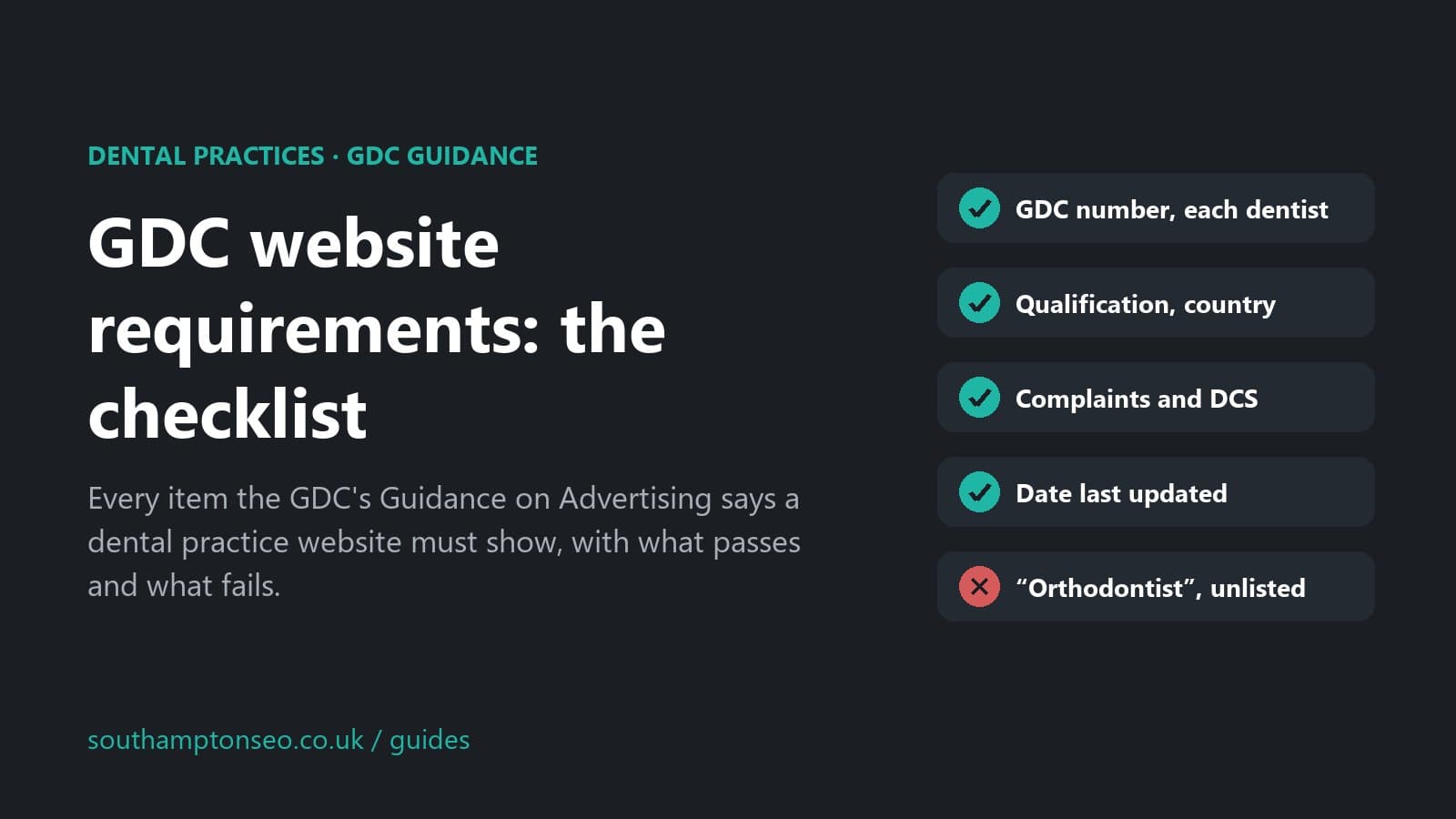
The General Dental Council's Guidance on Advertising sets two lists for websites. Every dental professional named on a site must show their professional qualification, the country it was gained in, and their GDC registration number. A practice website must also show the practice's name and address, its email and phone number, the GDC's contact details or a link to the GDC website, the complaints procedure with who to contact next (the NHS body for NHS treatment, the Dental Complaints Service for private treatment), and the date the site was last updated.
The rest of this guide takes each item in turn, in the GDC's own words, with what a passing and a failing version look like. It also covers the rules that catch practices out more often than the list itself: specialist titles, the courtesy 'Dr', claims, and promotions on social media.
The list for every dental professional on the site
The guidance says: "if you are mentioned on a website as a dental professional providing dental care you must ensure the following is displayed: your professional qualification and the country from which that qualification is derived; and your GDC registration number." That applies to every dentist, hygienist, therapist, nurse and technician the site names as providing care, not only the principal.
| Requirement | Passes | Fails |
|---|---|---|
| Professional qualification | BDS | "Experienced dentist" with no qualification shown |
| Country the qualification is from | BDS (University of Bristol, UK) | BDS, with no country, for a dentist who qualified abroad |
| GDC registration number | GDC No. 123456 on the profile, linked to the online register | Numbers only on a separate 'compliance' page, or missing for the newest associate |
The list for the practice website
If you are responsible for a practice website, the guidance says you must ensure the following is displayed. Each item below is quoted from it.
| The GDC requirement | Passes | Fails |
|---|---|---|
| "the name and geographic address at which the dental service is provided" | Full address in the footer of every page, matching the Google profile | A PO box, or a head-office address for a group practice |
| "contact details of the dental service, including e-mail address and telephone number" | Phone and email in the footer and on the contact page | A contact form only, with no email address |
| "the GDC's address and other contact details, or a link to the GDC website" | A link to gdc-uk.org in the footer | Nothing, or a GDC logo with no link |
| "details of the practice's complaints procedure and information about who patients may contact if they are not satisfied with the response", namely the NHS body for NHS treatment and the Dental Complaints Service for private treatment | A complaints page naming the practice process, the NHS route and the Dental Complaints Service | "Please speak to the practice manager", with no onward route |
| "the date the website was last updated" | A 'last updated' date that changes whenever the site changes | A copyright year in the footer, or a date typed in by hand three years ago |
Two further duties sit in the same section. The information must be updated regularly "so that it accurately reflects the personnel at the practice and the service offered", which in practice means the team page changes the week someone joins or leaves. And the site must not display information comparing the skills or qualifications of one dental professional with those of others.
NHS, mixed or private
Elsewhere in the guidance, under advertising services, is a requirement many sites miss: "You must make clear in advertisements and other practice publicity whether the practice is NHS (or equivalent health service), mixed or wholly private." The simplest place is the new-patients page and the fees page, stated in the first line.
Specialist titles
This is the rule most likely to cause a problem, because it is easy to break with a single word. A dentist on a GDC specialist list can use the title 'Specialist' or describe themselves as a 'specialist in' that field. A dentist who is not on a specialist list must not use titles which may imply specialist status, such as Orthodontist, Periodontist or Endodontist, and must not describe themselves as 'specialising in' a form of treatment. They may say they have a 'special interest in', are 'experienced in', or that their 'practice is limited to' it.
There are no specialist lists for dental care professionals, and the guidance gives 'Smile specialist' and 'Denture specialist' as examples of titles that could mislead. Check every page, not only the team page: treatment pages, image alt text, the page title and meta description that appear in Google, and the practice's Google profile.
The courtesy title 'Dr'
Dentists may use 'Dr' as a courtesy title, but the GDC says they must not imply that they are medical doctors unless they are also registered with the GMC. Its recommendation is to make it clear, for example 'Dr A Smith, Dentist' or 'Dr B Patel, Dental Surgeon'. On a website that means the role sits next to the name everywhere the name appears.
Claims, qualifications and letters after a name
- Claims must be backed up with facts, statements must not be ambiguous, and nothing should create an unjustified expectation about results. 'Pain-free', 'perfect smile' and 'the best implant dentist in Hampshire' fail all three.
- Language must be clear and likely to be understood by patients.
- Memberships, fellowships and honorary degrees must not be listed in abbreviated form, because patients may read the letters as qualifications. Write them out in full.
- If a dentist offers treatment beyond what their primary qualification covers, such as facial aesthetics, the site should make clear that they have undertaken extra training, and must not suggest the dental degree alone qualifies them.
Promotions on social and marketing sites
If you promote treatment on marketing or social networking sites, the guidance names Instagram, TikTok, LinkedIn, Groupon and X, you must make clear that the treatment may not be appropriate for every patient and that it is conditional on a satisfactory assessment. A whitening or aligner offer without that caveat breaches the guidance, whatever the price.
What the GDC list does not cover
- The CQC. It registers and inspects dental practices in England but does not rate them, so the rating-display rule that applies to rated health services does not apply to a dental practice.
- Facial aesthetics. If the practice offers botulinum toxin, the ASA's rules on prescription-only medicines apply to those pages too.
- Data protection. A contact or booking form collects health information; the privacy notice must say how it is handled.
A fifteen-minute self-check
- Open the team page. Does every person who provides care have a qualification, a country and a GDC number?
- Search the whole site for 'specialist', 'specialising', 'orthodontist', 'periodontist', 'endodontist' and 'implantologist'. Is every use backed by a specialist list entry?
- Is 'Dr' always followed by 'Dentist' or 'Dental Surgeon'?
- Does the footer show the full address, phone, email and a link to the GDC?
- Is there a complaints page that names both the NHS route and the Dental Complaints Service?
- Is there a 'last updated' date, and is it recent?
- Do the new-patient and fees pages say whether the practice is NHS, mixed or private?
- Do any letters after names appear in abbreviated form for memberships rather than qualifications?
- Does every social media offer say the treatment depends on an assessment?
This checklist quotes the GDC's Guidance on Advertising, effective from 30 September 2013 and still the current guidance on the GDC's site when we checked. It is not legal advice; the GDC's page is the authority, and your indemnity provider can advise on a specific case.
Sources
- General Dental Council: Guidance on advertising (effective 30 September 2013)
- General Dental Council: Standards, principle 1 FAQ (use of the courtesy title 'Dr')
- Care Quality Commission: How providers must display ratings
- CAP: Botox, frequently asked questions (23 January 2020)
Written by
Web developer and SEO specialist at Webso Digital, working remotely from Wrexham for marine businesses, clinics and Southampton firms. Builds the sites by hand and writes the guides from the work. Not a lawyer: where a guide covers a rule, it quotes the regulator and links to it, and the regulator's page is the one to rely on.
Questions on this topic
Does every dental nurse need their GDC number on the website?
If the site names them as a dental professional providing dental care, yes: the requirement applies to anyone mentioned in that way, not only dentists. If the site lists a person only in a non-clinical role, it does not apply to them in that role.
Is a copyright year enough for 'the date the website was last updated'?
No. A copyright year says when the site claims copyright, not when its content was last changed. The safest version is a date the site generates itself whenever a page changes.
What happens if our website does not comply?
The guidance says advertising that is false, misleading or has the potential to mislead is unprofessional, may lead to a fitness to practise investigation, and can be a criminal offence. In practice most problems are found and fixed before that, but every registrant named on the site is responsible for checking that what it says about them is correct.